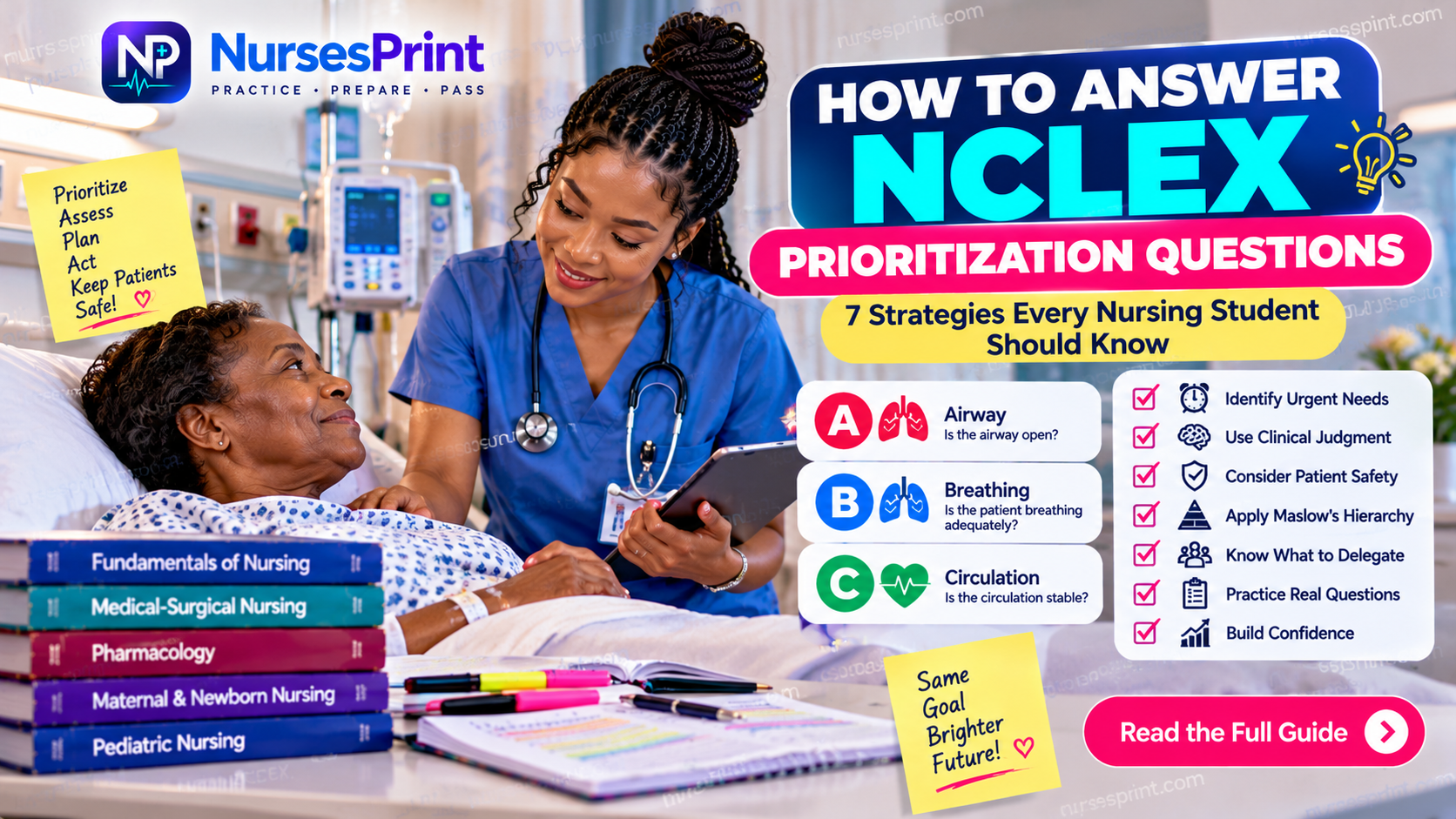
NCLEX prioritization questions can be challenging because they require nursing students to identify which patient needs immediate attention. Unlike straightforward knowledge questions, prioritization scenarios evaluate your ability to make safe clinical decisions under pressure.
Understanding how to assess urgency, recognize complications and apply nursing principles can significantly improve your examination preparation.
Whether you are preparing for the NCLEX-RN or reviewing fundamental nursing concepts, these seven strategies will help you approach prioritization questions with greater confidence.
1. Apply the ABCs of Nursing Prioritization
The ABC framework represents Airway, Breathing and Circulation.
It helps nurses recognize potentially life-threatening problems requiring immediate intervention.
When evaluating patient scenarios, consider:
Airway: Is the patient's airway open and protected?
Breathing: Is the patient experiencing respiratory difficulty?
Circulation: Are there signs of inadequate blood circulation?
For example, a patient experiencing severe respiratory distress generally requires more urgent attention than a stable patient requesting routine assistance.
However, always evaluate the complete clinical situation before making a decision.
2. Identify Unstable Patients Before Stable Patients
Patient stability is an important consideration when answering NCLEX priority questions.
Unstable patients may experience sudden changes in vital signs, altered consciousness or rapidly worsening symptoms.
Stable patients generally have predictable conditions without immediate signs of deterioration.
When deciding which patient to assess first, look for unexpected findings that suggest an urgent clinical problem.
Prioritize the patient with the greatest immediate risk rather than automatically selecting the patient with the most serious diagnosis.
3. Use Maslow's Hierarchy of Needs
Maslow's hierarchy provides a useful framework for understanding human needs.
Physiological requirements such as oxygenation, hydration and circulation generally take priority over less urgent psychosocial concerns.
For example, addressing significant breathing difficulties usually takes precedence over discussing routine discharge instructions.
Nevertheless, immediate safety threats may change the appropriate priority.
Use Maslow's hierarchy as a guide rather than an inflexible rule.
4. Recognize Acute Changes in Patient Conditions
Unexpected changes in patient status often require prompt assessment.
Important warning signs include:
Sudden confusion
New chest discomfort
Severe breathing difficulties
Unexpected bleeding
Rapid deterioration in vital signs
The Agency for Healthcare Research and Quality provides educational resources emphasizing patient safety and effective healthcare practices.
Recognizing clinical deterioration can help you identify the most appropriate nursing response.
5. Understand Assessment Versus Intervention
NCLEX questions sometimes require you to decide whether assessment or intervention should occur first.
Assessment is often appropriate when additional information is needed to determine the patient's condition.
However, immediate intervention may be necessary when an urgent threat is already clearly established.
For example, a nurse should not delay an essential emergency response merely to complete an unnecessary assessment.
Always consider what information is available and whether delaying action could compromise patient safety.
6. Practice Prioritization Questions Consistently
Regular practice helps you apply nursing frameworks to realistic examination scenarios.
When reviewing questions, identify the clinical findings that indicate urgency.
Ask yourself why one patient requires attention before another.
You can explore nursing exam preparation resources through NursesPrint to strengthen your understanding of important nursing concepts.
Review explanations carefully rather than memorizing correct answers.
This approach encourages stronger clinical reasoning.
7. Understand Delegation and Nursing Responsibilities
Prioritization questions may also involve deciding which responsibilities can be delegated.
Safe delegation depends on patient stability, task complexity, staff competency and applicable nursing regulations.
Registered nurses retain responsibility for appropriate assessment and clinical judgment.
The National Council of State Boards of Nursing provides professional guidance about nursing delegation.
Understanding these principles can help you distinguish appropriate delegation from responsibilities requiring licensed nursing judgment.
Final Thoughts: Improve Your NCLEX Prioritization Skills
Mastering NCLEX prioritization questions requires more than memorizing nursing frameworks.
You must recognize urgent patient needs, interpret clinical information and select safe nursing actions.
By applying the ABCs, evaluating patient stability and practicing realistic scenarios, you can strengthen your clinical judgment.
Remember that patient safety should guide your decision-making throughout the examination.
Ready to strengthen your NCLEX preparation?
Visit NursesPrint to explore nursing study resources and develop the confidence needed to approach challenging examination questions.
Practice Smarter. Think Critically. Prepare With NursesPrint.